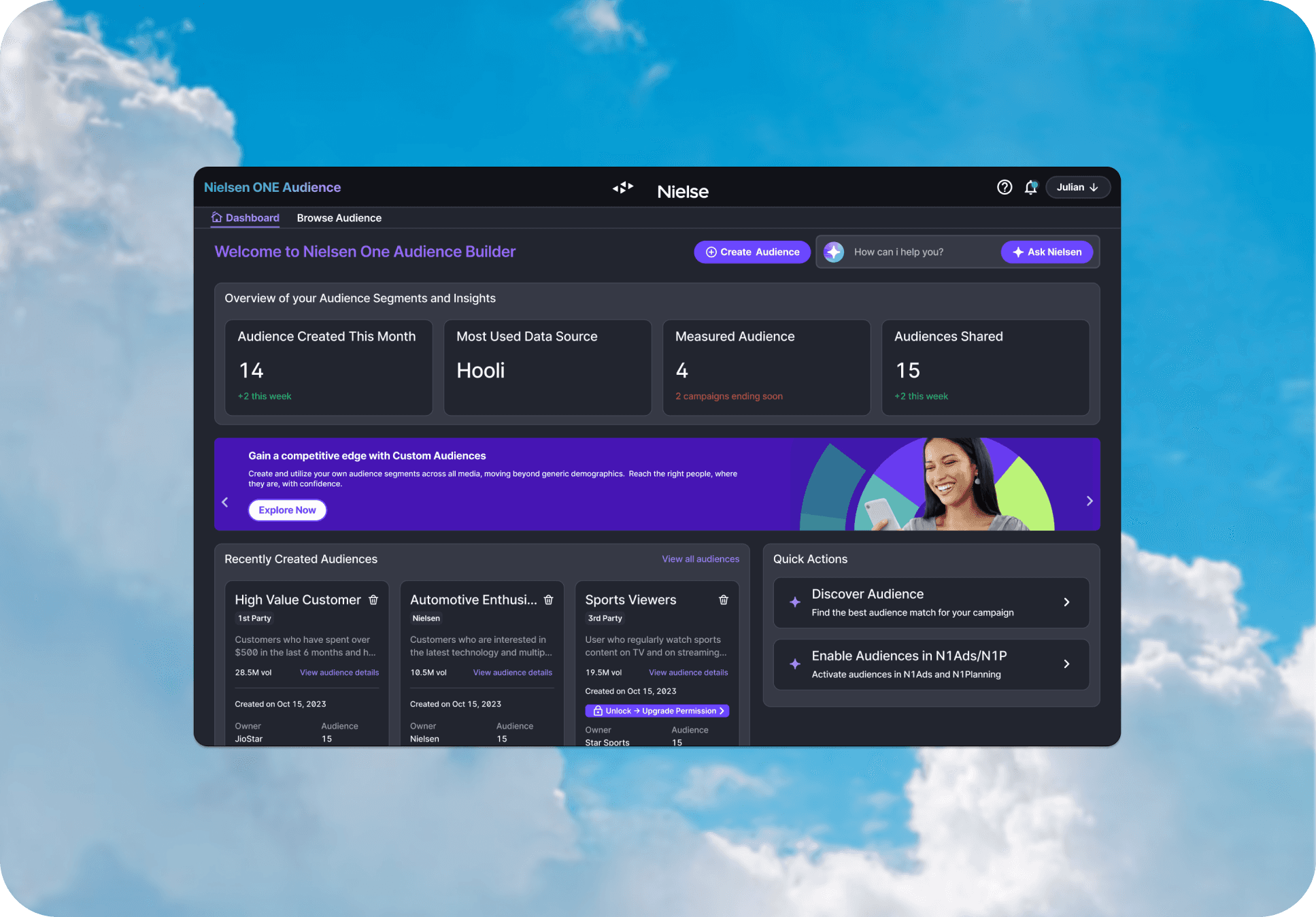
Redesigning the audience measurement product

audience creation workflow as part of the broader Nielsen One experience

Timeline

Timeline

Oct 24 - Jun 25

Oct 24 - Jun 25

Role

Role

Product Designer

Product Designer

Live Product

Live Product

Team

Team

1 Designer, 2 PM's, 3 Developers

1 Designer, 2 PM's, 3 Developers

What is Audience Manager?

What is Audience Manager?

A secure enterprise platform used to share, select, and activate target audience data for advertising campaigns.

A secure enterprise platform used to share, select, and activate target audience data for advertising campaigns.

It is used by large media and advertising companies including NBCUniversal, CBS, ESPN, Microsoft, and Google. The target audiences are created here and then directly feeds into Nielsen's campaign planning tools, making it a critical link between how audiences are defined and how campaigns are executed.

It is used by large media and advertising companies including NBCUniversal, CBS, ESPN, Microsoft, and Google. The target audiences are created here and then directly feeds into Nielsen's campaign planning tools, making it a critical link between how audiences are defined and how campaigns are executed.

The Brief

The Brief

How can Audience Manager better support rapid audience building, combining, and exclusion workflows?

How can Audience Manager better support rapid audience building, combining, and exclusion workflows?

Current audience creation was built around static, file-based selection. While technically functional, audiences had to be built in isolation, exported, reworked in a legacy tool, and then re-uploaded - a process that created friction at every step. It surfaced repeatedly in client feedback, impacting both usage and adoption alongside Nielsen's planning tools.

Current audience creation was built around static, file-based selection. While technically functional, audiences had to be built in isolation, exported, reworked in a legacy tool, and then re-uploaded - a process that created friction at every step. It surfaced repeatedly in client feedback, impacting both usage and adoption alongside Nielsen's planning tools.

The Objective

Improved usage without increased cognitive load

Improved usage without increased cognitive load

minimising disruption to established client behaviours

Working within existing structures

not compromising system performance at enterprise scale

not compromising system performance at enterprise scale

Building a future scope AI integrated version

exploring use cases where AI could support audience creation

The Solution

The Solution

A query based audience builder

A query based audience builder

The shipped solution is a dedicated visual workspace where users can iterate audiences with queries and activate them within ad plans. This make audience creation flexible and bridges a key gap between audience creation and activation.

The shipped solution is a dedicated visual workspace where users can iterate audiences with queries and activate them within ad plans. This make audience creation flexible and bridges a key gap between audience creation and activation.

Creating an alternative path

Creating an alternative path

The new flow needed to be visible at the right moment without adding cognitive overhead. It was embedded within the existing pre-creation screen as an alternate path to the existing audience creation flow, with both systems coexisting.

The new flow needed to be visible at the right moment without adding cognitive overhead. It was embedded within the existing pre-creation screen as an alternate path to the existing audience creation flow, with both systems coexisting.

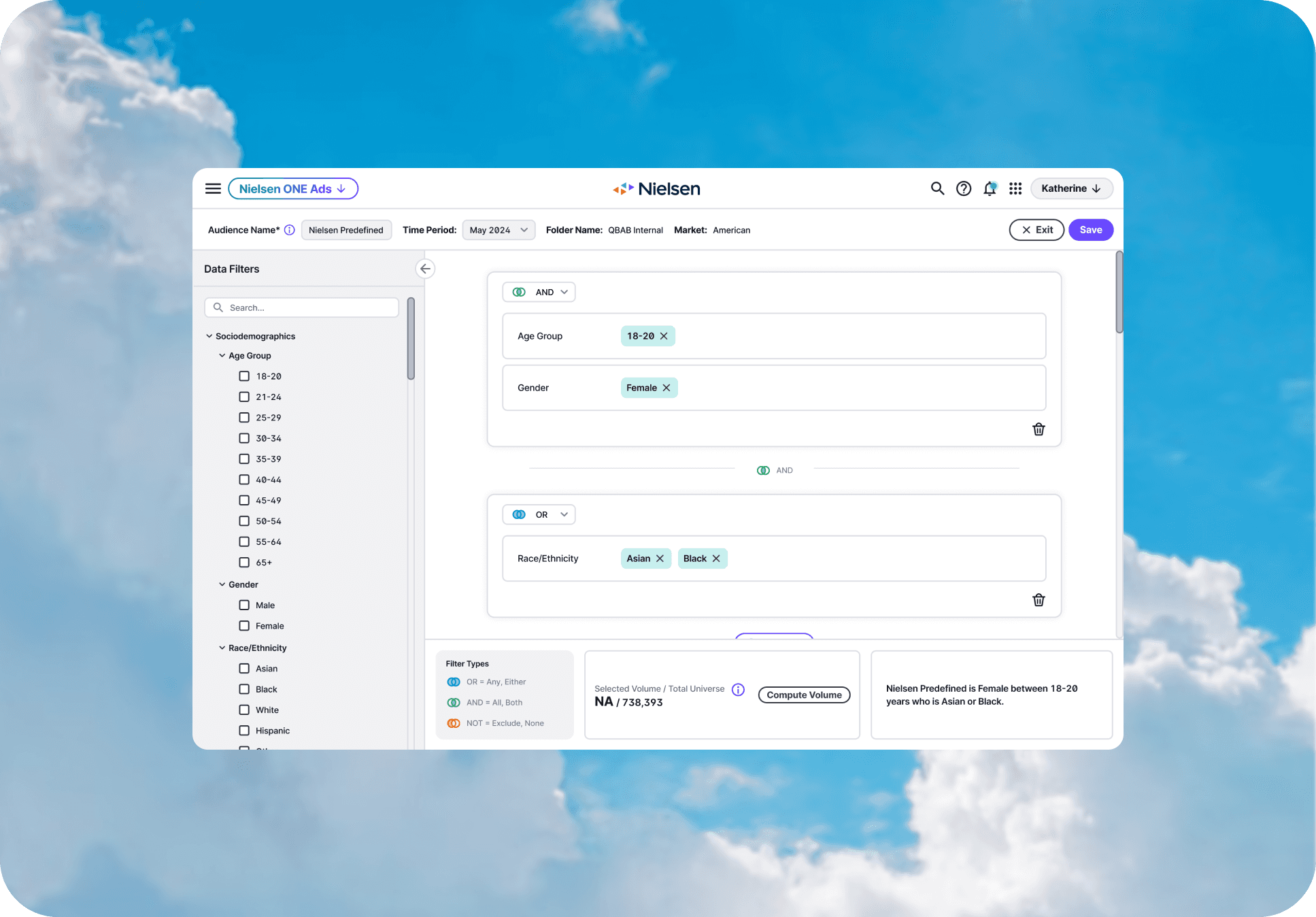
Using AND, OR & NOT logic for iterations

We made use of the effective AND, OR & NOT logic loops, allowing customising data across months. This mirrored the same logic which was used in Nielsen's legacy interfaces. The intent was to stay close to how users already think.
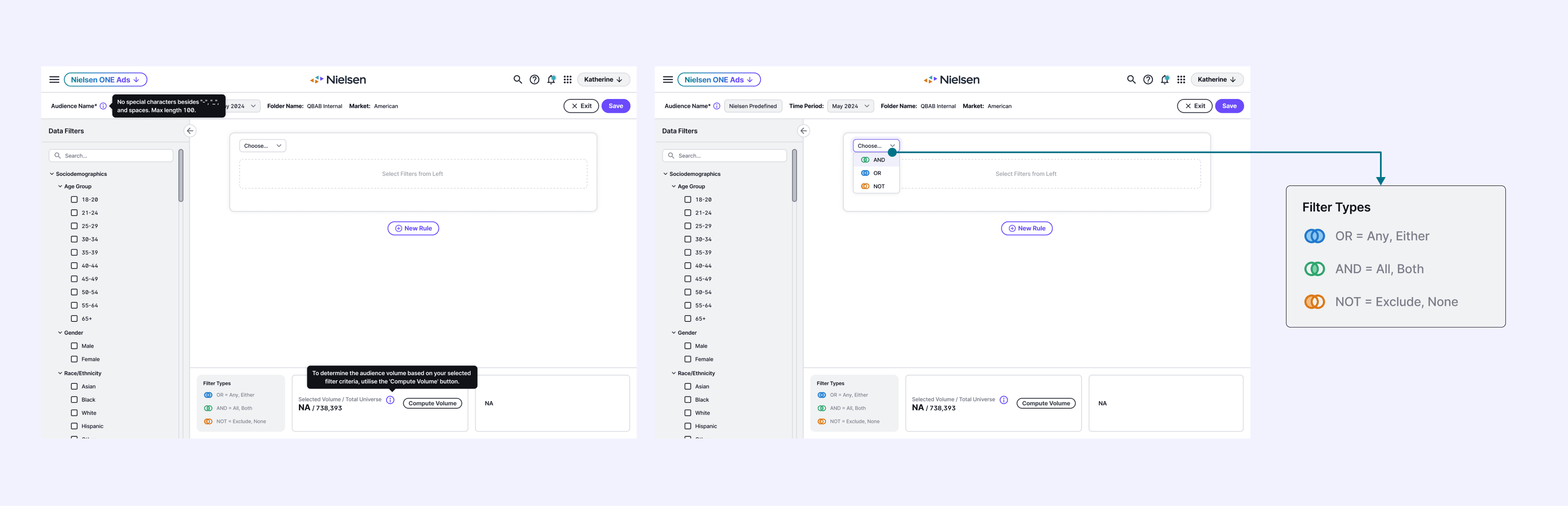
The query design

The query design

When audience iterations gets complex, how does a user actually understand what they've built? For this, we used NLP to write a single line audience description, updating with every change, giving a readable summary of their logic. To prevent overdoing iterations and getting a really small audience size, we built guardrails like universe size, audience size and prevented saving audiences below a minimum threshold.

Process Pivots

Process Pivots

Some important questions came up and pivots happened in the process which we had to answer for, like -

Some important questions came up and pivots happened in the process which we had to answer for, like -

The AI Vision

A future concept for AI-assisted audience creation

The AI shift in product thinking was gaining momentum, and audience building felt like a natural fit. Users could generate audiences through natural language while retaining full manual control, automatic audience descriptions, auto-naming conventions, and direct handoff into planning workflows were some of the features explored.

The AI shift in product thinking was gaining momentum, and audience building felt like a natural fit. Users could generate audiences through natural language while retaining full manual control, automatic audience descriptions, auto-naming conventions, and direct handoff into planning workflows were some of the features explored.

Outcome

Outcome

The feature has shipped, been well received, and entered core workflow.

The feature has shipped, been well received, and entered core workflow.

Apart from increased client adoption and faster workflows, the audience AI concept also became the very first to be tested and showcased in the company, kickstarting Nielsen's AI product upgrade journey.

Apart from increased client adoption and faster workflows, the audience AI concept also became the very first to be tested and showcased in the company, kickstarting Nielsen's AI product upgrade journey.

Reflection

Reflection

This project was a lesson in ownership at scale.

This project was a lesson in ownership at scale.

Balancing user needs when direct feedback wasn't always available, advocating for design-first decisions at the right moments, technical constraints in a fast moving agile environment, deeply understanding legacy products and having a future vision, taught me quite alot. I’m happy to chat more about my process over a call. Reach out to me at bhavikamalik@u.nus.edu !